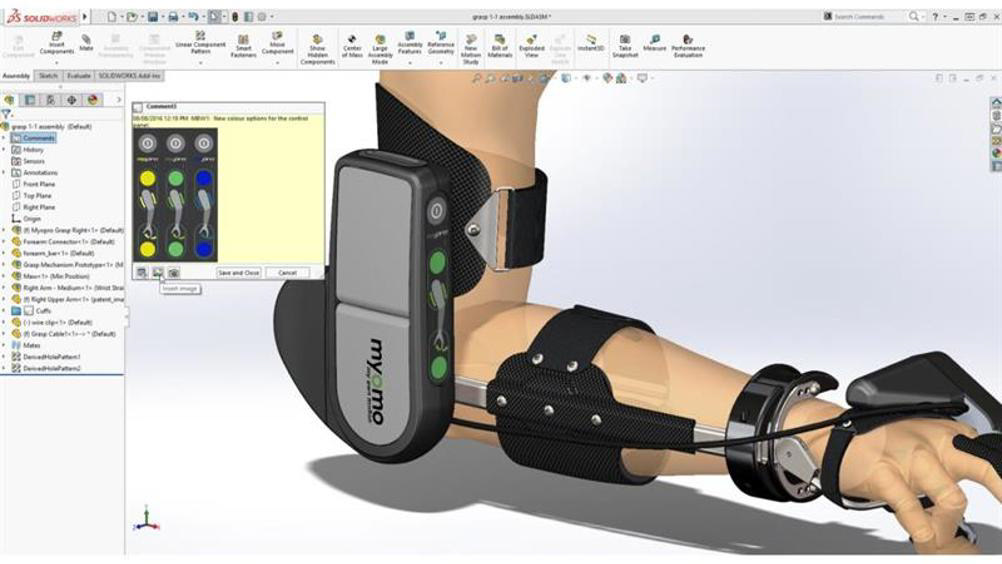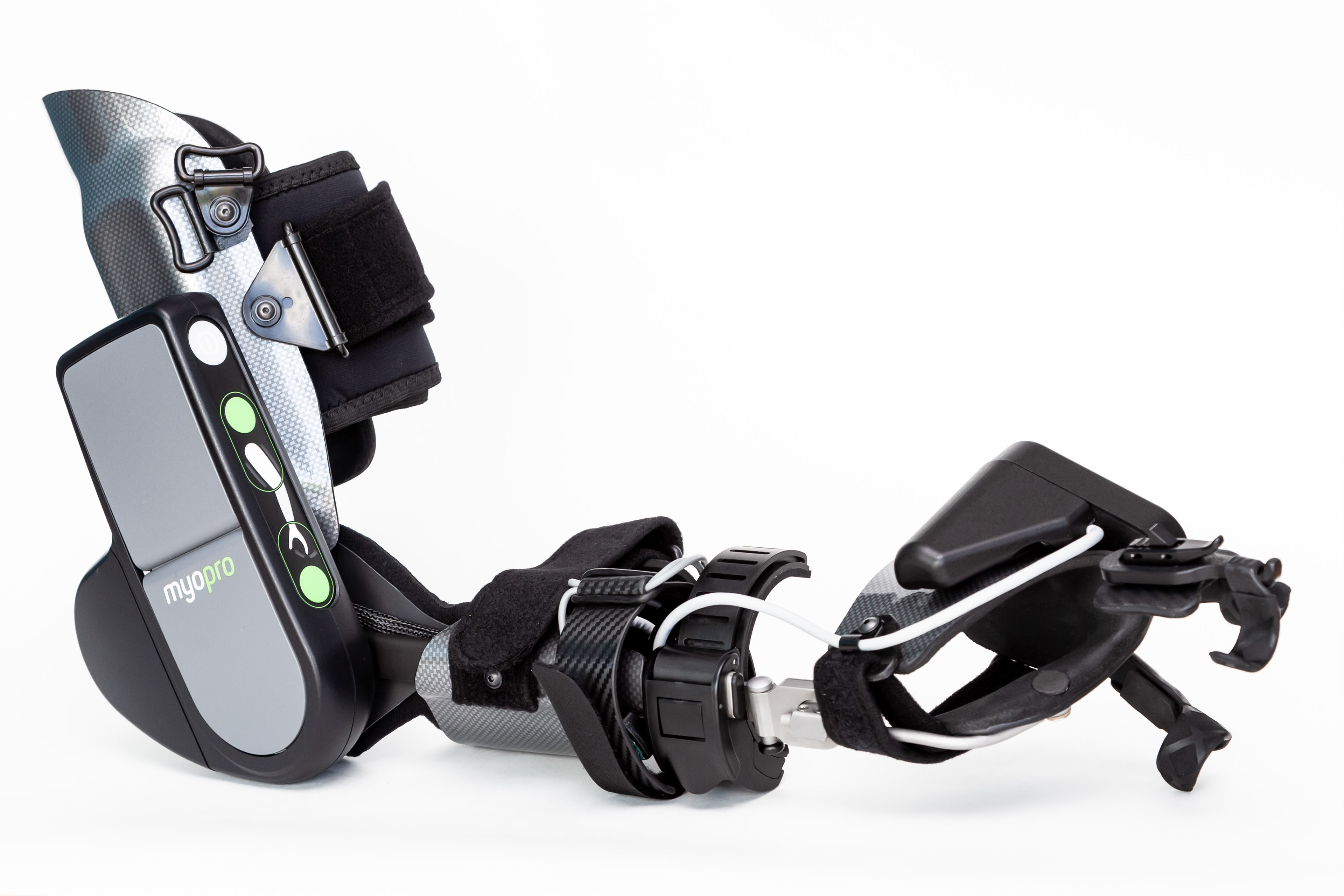
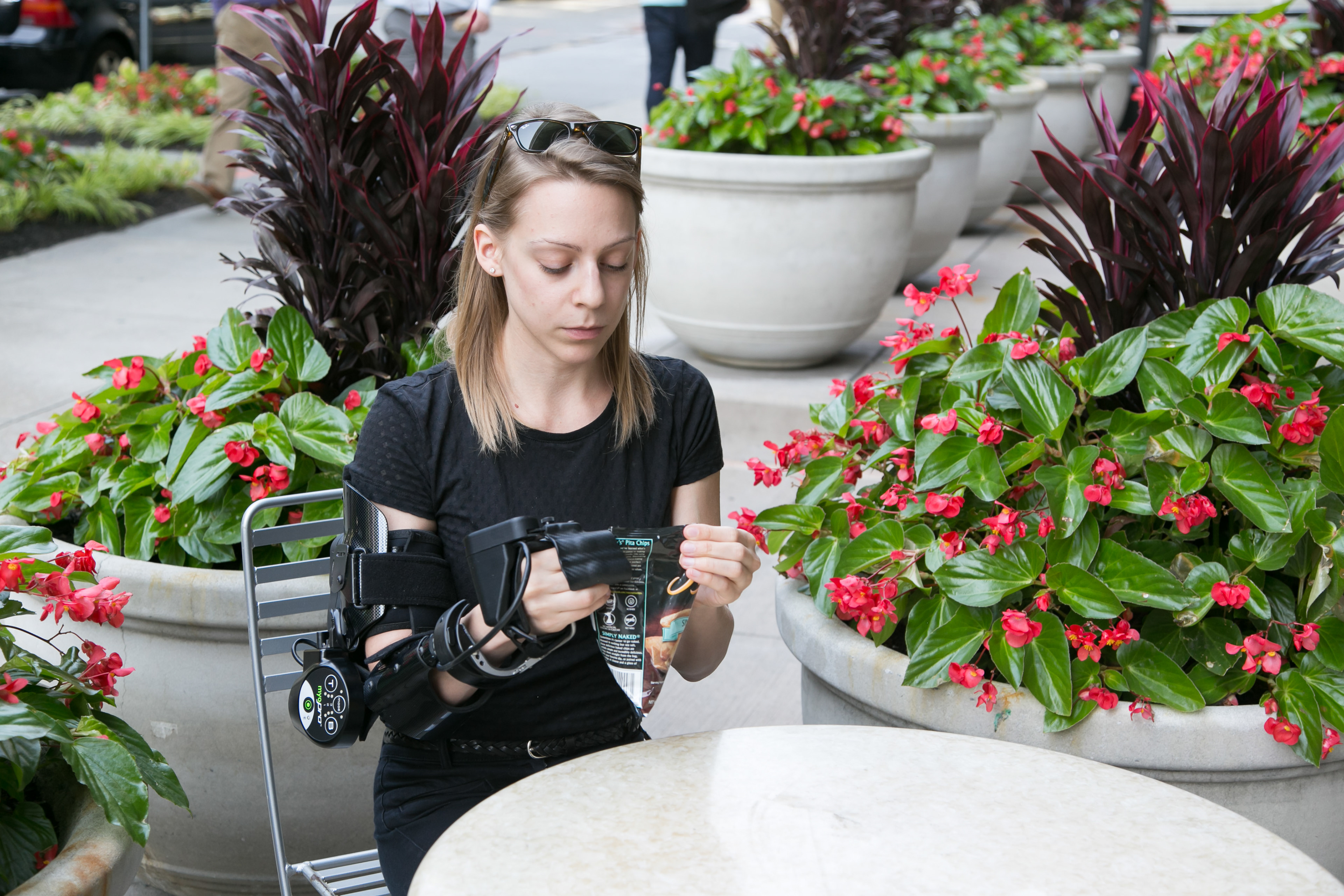
The MyoPro is a Class 2 medical device intended to be used by individuals suffering from upper extremity paralysis. It operates as a powered brace with two active and two passive degrees of freedom. Custom sEMG sensors detect the wearer's trace neurological signals, and can use those as a command input to allow the operator to control the brace. This creates an extremely intuitive interface where the act of trying to move a paralyzed muscle results in the arm moving as if the user had full control over their affected limb.
The MyoPro 2 represents a second generation of the flagship product. As I was the only hardware engineer on staff, I was responsible for the mechanical design of the entire device.
On this project, I:
- Developed and patented a novel hand actuator and finger support system to open and close the index and middle fingers in a three-jaw-chuck configuration
- Identified and resolved a critical sweat-based performance issue with sEMG sensing array through controlled experiment design for reproduction, system isolation, and resolution validation
- Completely overhauled the design of the elbow module, increasing torque output, heat rejection, and adding a removable lithium-ion battery to dramatically increase runtime over the previous generation embedded NiMH pack.
- Managed an external ID resource to develop the exterior look and CMF, and then I performed all of the design work to take surfaced exteriors and convert them into manufacturable injection molded components.
I was honored to have my models chosen as the launch demonstration for Solidworks 2017. In addition to having my CAD work highlighted, I presented alongside Dassault leadership to demonstrate how we use some of the features of Solidworks to enable rapid development