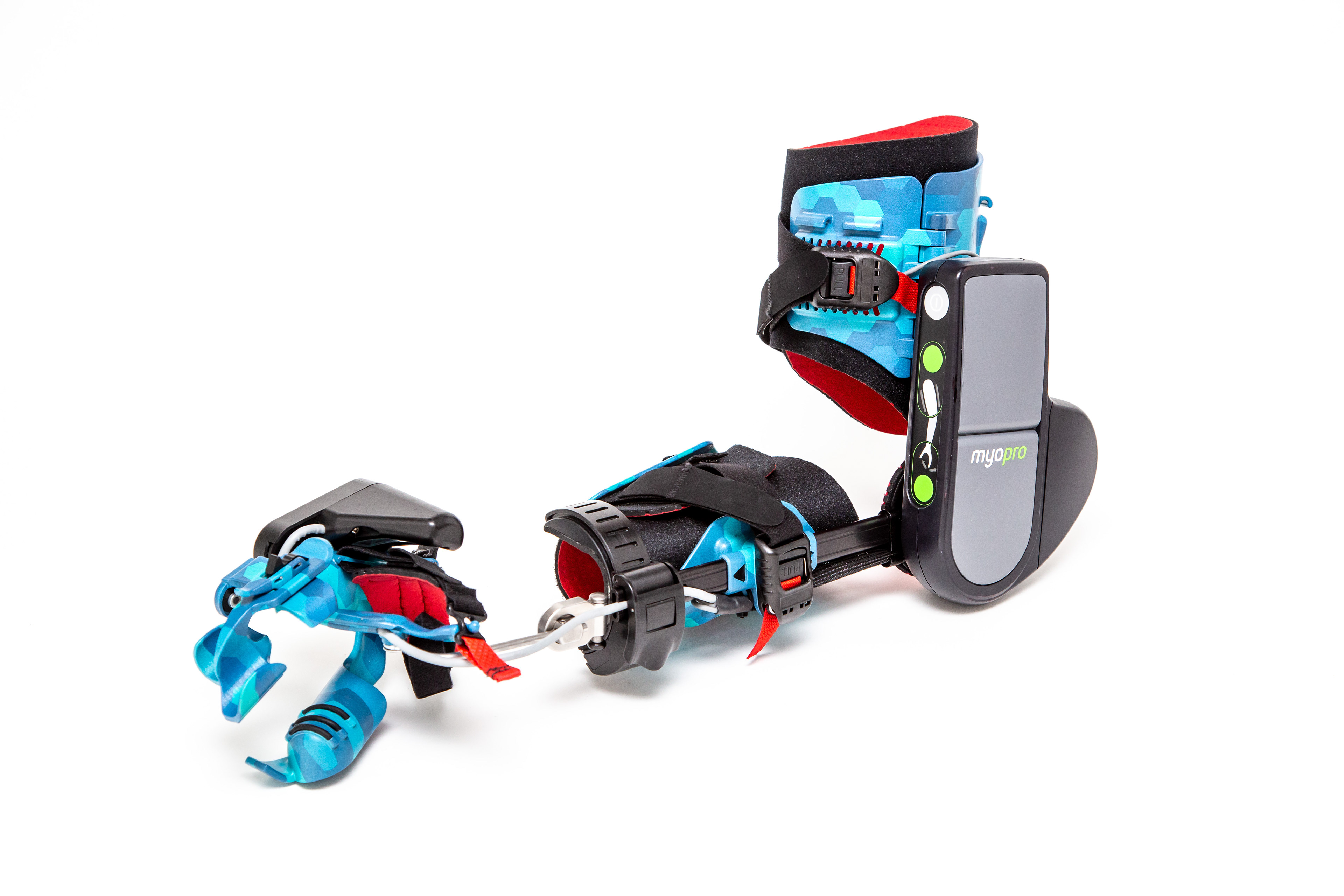
The MyoPro 2+ was a pivotal change to the production methodology for the upper extremity exoskeleton. As the MyoPro 2 saw additional volume increase, there was more pressure to scale production to meet demand across the United States. However, a major production bottleneck was in the traditional O&P techniques used to produce the orthotic elements. This included many skilled handwork operations such as paper templating, warm-and-form techniques, grinding, drilling, and skiving to form each brace to the exact shape of the user. This led to bottlenecks both in throughput and access to labor skilled in the art.
To help Myomo scale, I developed a digital pipeline that would allow the orthotic elements to be produced via a 3d printed PA12 shell set. In addition, the user could select colors, graphics, or patterns to allow them to personalize their brace.
On this project, I:
- Developed a digital workflow using data input files through the Solidworks API and macro tools to automate scaling, customization, and 3MF file generation, which could operate with very minor interactions, requiring significantly lower operator skill.
- In addition to leading the technical team, I was also the IC for the forearm and humeral cuff subsystems, as well as the forearm bar structure
- Led the development of a digital shape capture system to obtain user measurements. During the height of the COVID-19 pandemic, capturing user shapes by having clinical team members drive or fly to meet patients was no longer possible. Instead, we developed a briefcase that contained scanning and measuring equipment, along with a tablet that could run a telehealth session with a clinical team member of Myomo. This enabled clinicians to intake more users, and significantly reduced travel costs, by replacing them with standard UPS shipping of a ruggedized briefcase.
- Developed a new functional behavior set called "Advanced Dual Mode" which allowed the existing sensing and control hardware to provide more functional benefits to the user by allowing the clinician to use a graphical interface to change the proportional relationship between signal strength and motor command. This let the device be tuned in a more simple-to-use mode for novice users, and a more capable function set for advanced users.