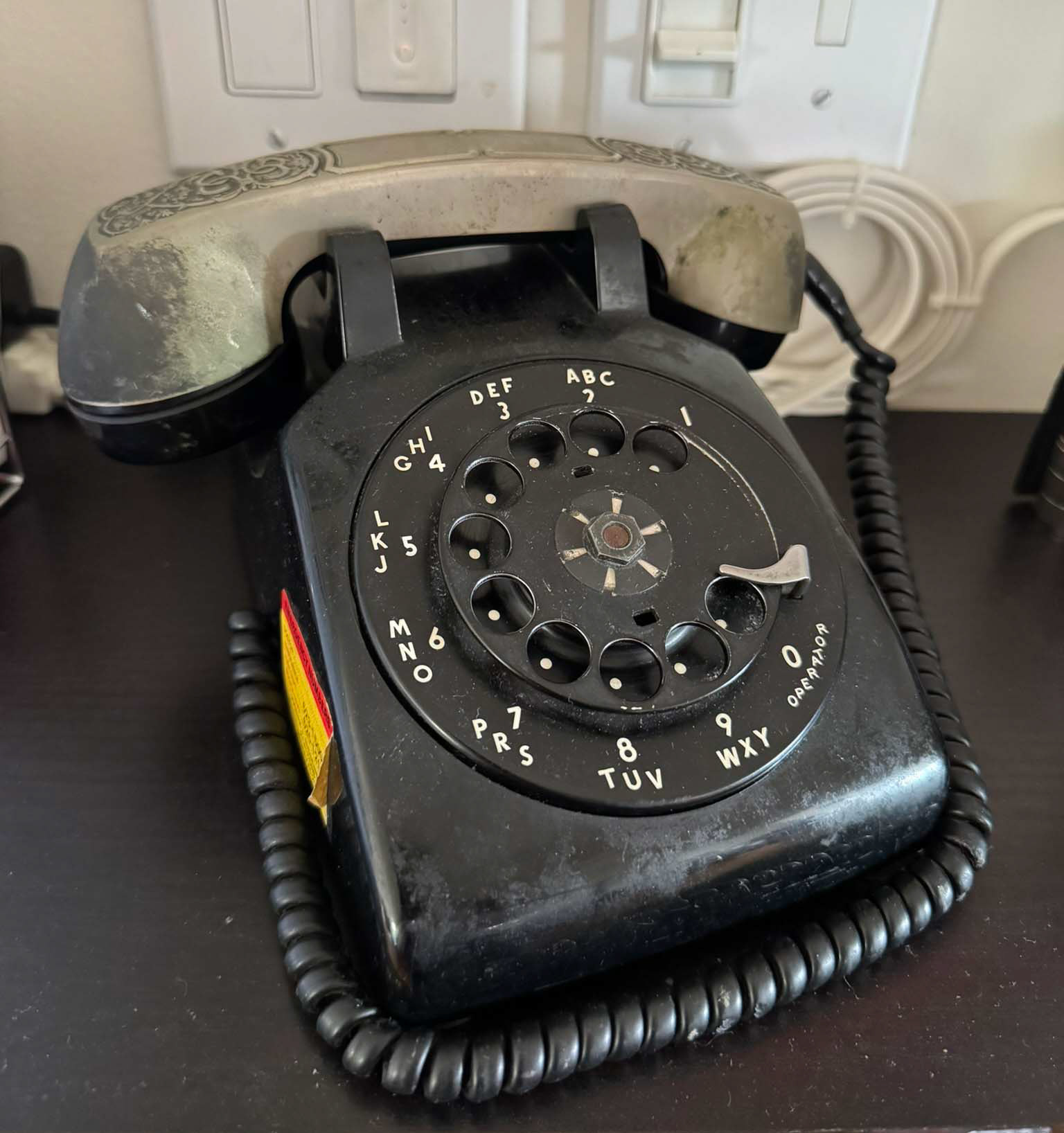
One day during 2016 I was walking in Somerville and came across an estate sale. Inside, I found a Wester Electric Model 500 rotary phone which had such as satisfying feel to dial on. Being in the middle of nerding out on other home automation projects, I decided to turn it into a glorified light switch with 10 programmed scenes.
To achieve this, I gutted the phone except for the rotary selector mechanism and cradle switch. The rotary selector is simply a pair of switches. One switch opens when the dial is not at its home position, and the other pulses on the passing of each digit during the return phase of the rotation. This means that in order to identify what number was dialed, you must simply count the number of pulses on switch 2, and when switch one is closed, return the number you counted. Pretty easy!
To implement this, I used an ESP-8266 (the ESP32 wasn't released until later that year!) as a WiFi endpoint with enough GPIO to read the phone's physical interfaces. The lighting being controlled belong to the Philips Hue family, which as a JSON API. Modifying the ESP-8266 to send JSON messages to a static IP succeeded in sending control signals. What's even better is that I could use the Philips Hue interface to reassign what the scenes looked like, as long as they kept a fixed name descriptor. I programmed the cradle switch to dim the lights out over a 5 second period to give it a dim-to-off feature that I couldn't get with the Philips Hue standard switch configurations.
For power, I modified the original entry port where a telephone cable would enter to instead take a 5V barrel plug, and then paired it with an OTS wall wart. This phone was old enough that there was no standard modular RJ-11 jack, but instead just a cable mousehole with a strain relief and internal wiring to screw terminals.
I had a few thoughts about possibly using the ringing mechanism as an output or just a fun way to surprise guests. However, a Model 500 runs its ringer off of a 90V, 20Hz AC signal, which wasn't going to be particularly easy to interface with without higher power switching hardware and a beefier wall wart.
Overall, it's a fun mechanism that's satisfying to use, and typically surprises guests